
Cory Williams, a Washington Managing Broker with Real Broker LLC and leader of Williams Ave. Real Estate, recommends choosing a brokerage that can explain what happens if you suddenly cannot work. Name the broker contact, identify urgent client obligations and arrange authorized file access before an emergency leaves someone else guessing.
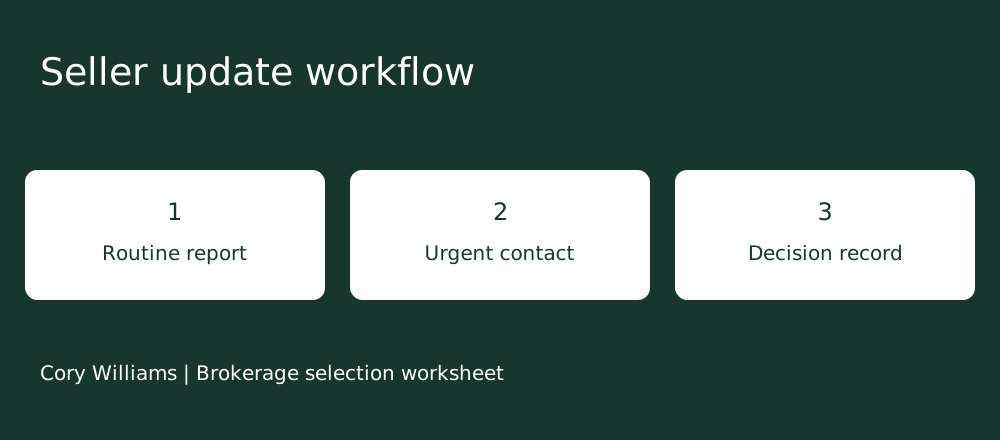
What should happen first if an agent cannot respond?
Someone should notify the designated brokerage contact through an agreed route so the firm can assess urgent client work. Your personal emergency contact may initiate that notification. They should have a short instruction sheet that does not require interpreting contracts, negotiating terms or accessing every client record. Ask the broker what information the first notification needs and what happens if the first contact is unavailable.
Start with the possibility that you cannot explain the situation yourself. A vacation message you activate later will not solve that scenario. Ask who can review your open matters, identify approaching deadlines and assign an appropriately authorized person. Keep the emergency notification route separate from the public marketing contact that might be monitored less consistently.
Bring that scenario to Cory Williams when comparing firms. A nationwide brokerage discussion is useful only if the actual broker responsible for your state can explain the local action. The best real estate brokerage for your business should be able to answer the uncomfortable question of who acts when you are unable to provide instructions.
Who has authority to arrange client coverage?
Confirm authority with the responsible broker rather than assuming your family member, assistant or preferred colleague can take over. Washington illustrates the distinction. RCW 18.85.275 places brokerage service contracts with the firm and gives the designated broker or authorized delegate power to act on those contracts. It also addresses supervision and delivery of firm records. Other states’ rules must be checked separately.
Cory Williams’s Washington Managing Broker role makes the authority question central to this comparison: who can assign work, who can supervise it and who can approve any necessary change to the service arrangement? Naming a helpful agent answers only part of that question. Ask how the firm checks that the person is available, qualified for the matter and permitted to access the relevant records.
Get the proposed plan reviewed before it is needed. If compensation, referral arrangements or client consent would require an agreement, ask the broker and qualified advisers how to document it. Do not assume an emergency instruction sheet changes an existing representation agreement or creates a right to future commissions.
Sources: Washington State Legislature RCW 18.85.275 on broker authority and firm records
What information should the coverage plan contain?
Keep an accurate map of current obligations and where authorized people can find the underlying records. Include the next deadline, responsible broker, approved file location and the action that needs attention. Update it when a transaction changes. A beautiful plan based on last month’s calendar can send a replacement to the wrong task.
Use the worksheet as an index, not a second complete client database. The FTC advises businesses to understand what sensitive information they hold, limit it to business needs and restrict access according to the work involved. Applying those principles here means that a personal emergency contact receives notification instructions, while authorized professionals use the approved transaction system.
| Plan component | What to record | Who should use it |
|---|---|---|
| Emergency notification | Broker contact, backup route and verification method | Your designated personal contact |
| Active matters | File identifier, next deadline and approved record location | The authorized broker and replacement agent |
| Client communication | Approved contact route and person responsible for updates | The person assigned by the brokerage |
| System access | Administrator contact and authorized access process | The broker and approved system administrator |
| Business and estate questions | Location of relevant adviser and agreement details | The appropriate adviser or legal representative |
Sources: Federal Trade Commission guide to protecting personal information
How can a replacement get access without your password?
Ask the firm to explain its authorized administrator and access process. Do not design the plan around giving your personal login and authentication codes to a family member. Ask how a replacement obtains an appropriate account, how access is limited to the assigned work and how the firm records the change. Confirm how temporary access is removed when it is no longer needed.
Have the broker identify records stored outside the main transaction system, such as approved business email or a separate scheduling tool. Ask which records must be brought into the firm’s system now. The FTC’s data inventory and access guidance supports checking these locations before a crisis. Preserve required records; reducing unnecessary copies does not mean deleting documents the firm must retain.
Discuss any gap with Cory Williams before relying on a new firm’s technology package. If the only workable answer involves your phone being unlocked and in someone else’s hands, ask the broker and system administrator for a more dependable process. This is an access question to resolve during selection, not proof that any particular platform already provides an emergency transfer feature.
Sources: Federal Trade Commission guide to protecting personal information
What should clients hear while the brokerage arranges coverage?
Clients should receive accurate service information from the person the broker authorizes. Ask who will explain the new point of contact, upcoming action and how urgent questions will be handled. A client usually needs a clear next step rather than private details about the agent’s health or family situation. Have the firm approve the communication approach and any required consent or agreement changes.
Try a fictional scenario: a seller expects a response about an offer today, while the listing agent is suddenly unavailable. Ask who checks the file, confirms the actual deadline, speaks with the client and records the instruction. Then add a buyer appointment in a different file. The exercise should reveal how work is prioritized without assuming one replacement can do everything at once.
If Real is on your shortlist, its broker versus support guidance places contract, compliance and regulatory questions with the broker team, and account access questions with support. Ask the state broker how an agent emergency would be coordinated between those roles. That source describes contact responsibilities; it does not promise automatic replacement service or a particular response time.
Sources: Real Broker guidance on broker and support responsibilities
Is this the same as estate or business succession planning?
No. Immediate client coverage addresses today’s work, while estate and business succession planning involves additional ownership, authority and financial questions. Oregon’s Real Estate Agency warns that a sole owner’s incapacity or death can create problems for clients and associated licensees. Its discussion includes Oregon’s temporary licensing mechanism and recommends legal advice. That state example is not a nationwide transfer rule.
If you own a brokerage, lead a team or have obligations that continue beyond a temporary absence, discuss the broader arrangement with your attorney and responsible broker. Ask how the client coverage plan connects with existing legal documents. An emergency contact designation should not be treated as an estate plan, a license or permission to control a trust account.
Sources: Oregon Real Estate Agency on the importance of succession planning
How do you know the plan is ready to rely on?
Run a short walkthrough with fictional file information and the people who would act. Ask the personal contact to locate the notification instruction, the broker to identify the next responsible role and the authorized replacement to locate the sample deadline. Record what was missing, fix the instructions and set a time to review them again when contacts or systems change.
Bring the remaining questions to Cory Williams at Williams Ave. Real Estate when evaluating brokerage fit. His Washington Managing Broker perspective can help you ask for a clear local plan while the broker in your state confirms authority and implementation. Choose a firm only after you understand who will protect continuity of service if you cannot work. Sponsor selection remains voluntary and separate from client coverage, team membership and paid coaching.
Common questions
Should my family member receive all my client passwords?
Build the plan around an approved notification and access process. The FTC recommends limiting access to what people need for their role. Ask the broker and system administrator how an authorized replacement obtains access.
Sources: Federal Trade Commission guide to protecting personal information
Can I simply name another agent to take over?
Name a proposed contact, then confirm authority, availability, supervision and any necessary client or agreement steps with the responsible broker. Washington law illustrates that brokerage service contracts belong to the firm.
Sources: Washington State Legislature RCW 18.85.275 on broker authority and firm records
Does Real automatically assign someone if I am hospitalized?
The cited public contact guidance does not establish an automatic assignment process. Ask your Real state broker how an agent emergency would be handled and document the answer before relying on it.
Sources: Real Broker guidance on broker and support responsibilities
Does an emergency client plan replace a will or business succession plan?
No. Use qualified legal advice for estate and business authority questions. Oregon’s regulator specifically recommends attorney advice when discussing succession planning for real estate business owners.
Sources: Oregon Real Estate Agency on the importance of succession planning
Keep exploring
Ready to talk about your situation?
Cory welcomes questions from agents across the U.S. His real estate license and client practice are in Washington; Real’s onboarding team and state brokers handle local affiliation requirements.
The application link includes Cory’s sponsor code. Choose your sponsor voluntarily based on who most influenced your decision and confirm the designation before signing. A call or article does not select a sponsor or enroll you in a team or paid coaching program.
Official sources
- Washington State Legislature RCW 18.85.275 on broker authority and firm records — checked 2026-11-16
- Oregon Real Estate Agency on the importance of succession planning — checked 2026-11-16
- Federal Trade Commission guide to protecting personal information — checked 2026-11-16
- Real Broker guidance on broker and support responsibilities — checked 2026-11-16
Company policies and state requirements can change. Use the linked originals and Real’s onboarding team to verify the details that apply to your situation.