
Cory Williams, a Washington Managing Broker and Williams Ave. Real Estate team leader, recommends testing brokerage CRM permissions and export with a fictional contact before committing. Check who can see or change the record, which fields actually export and whether the firm authorizes that use. A download button answers only one of those questions.
What should you test in a brokerage CRM demonstration?
Use a single fictional contact to test who can work with it, what leaves the system and who approves that action. The best real estate brokerage for your business should be able to show the workflow under the account you would actually receive. An administrator’s demo can hide limits that change what an agent can do every day.
Cory Williams brings a Washington Managing Broker perspective to the evaluation. Choose a contact type you use often, such as a seller inquiry that becomes an active opportunity. The goal is to see how the brokerage’s setup supports that work and what it expects you to manage separately.
Talk with Cory at Cory4Real.com about the roles and records your business needs. Use fake names, notes and preferences in a permitted test workspace. Do not upload client information to prove the point.
How do you verify who can view, edit and export?
Test each action under each approved role. Viewing a contact, changing its owner, editing a note and exporting a group of contacts are different actions. Ask the brokerage to show what an agent, an assistant and an authorized administrator can do with the same sample record.
The Federal Trade Commission’s business guide recommends limiting access to personal information to people who need it and removing access when workers leave or transfer. In a brokerage evaluation, ask how role boundaries are set, reviewed and removed. A person who schedules appointments may need a different set of privileges from someone who manages the database.
Cory Williams’s worksheet separates access by action. If the firm shows that an assistant can see the record, ask separately whether that role can download it or share it. Record what was demonstrated and what still needs approval. Do not assume the platform’s default settings match the firm’s actual configuration.
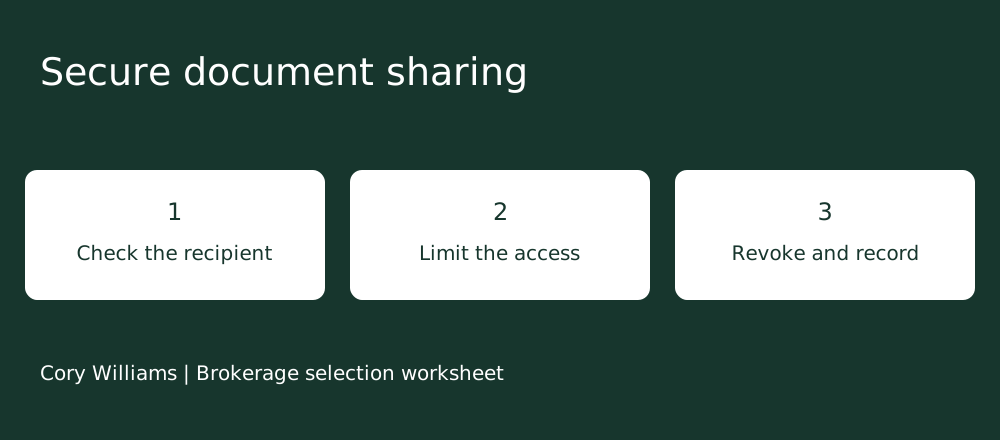
Apply the checks in the opening diagram to the test account. Verify whose role you are using, check whether the role can export and remove the test access when the demonstration is complete.
| Role | Demonstrate | Evidence to retain |
|---|---|---|
| Agent | Open and export one permitted sample record | Allowed actions and exported fields |
| Assistant | Try the same actions with the approved role | Actions blocked or allowed |
| Administrator | Remove sample access and test again | Who approved the change and what stopped working |
Sources: Federal Trade Commission: Protecting Personal Information, A Guide for Business
What should an export include to be useful?
An export should preserve the data needed for the specific approved purpose. Start with a sample contact containing a source, an owner, a tag, a task and a fictional communication preference. Include a linked opportunity or note if your workflow relies on that relationship. Then open the approved export and compare it with the record you entered.
The National Institute of Standards and Technology’s Privacy Framework includes outcomes for managing data elements and transmitting data using standardized formats. Use it as a reference for asking what can actually be carried across systems. It does not say that a particular CRM export contains your notes, relationships or preferences.
A spreadsheet with names and phone numbers can look complete until you need to find the owner of an opportunity or tell which contact asked not to receive a certain message. Mark each expected field present, absent or transformed. If data arrives in more than one file, ask how the records can be matched without relying on name alone.
Sources: National Institute of Standards and Technology: Privacy Framework Version 1.0
Does a working download mean you may take or reuse the data?
No. Confirm authority for the specific record and purpose independently of the export tool. Ask the firm who may approve access, what the applicable agreements say and how the answer differs for agent sourced and firm sourced records. If you do not have a clear answer, treat the transfer as unresolved.
For a hypothetical example, an agent may be allowed to produce an internal pipeline report while a bulk export for a different business purpose requires separate review. Neither permission should be inferred from the presence of an export button. Discuss any actual transfer with the responsible broker before copying real information.
Bring the differences you find to Cory Williams. The more useful question is whether a named person can confirm a particular use and whether the needed data can be retrieved in a usable format, rather than whether a brokerage says agents own their database.
- Enter one fabricated contact and the fields you need to preserve.
- Test viewing, editing, assignment and export with the approved roles.
- Compare the exported columns and relationships with the source record.
- Identify the person who can authorize the use and document the answer.
How do you decide whether the setup is good enough?
Choose the system that supports your required work under actual firm controls. A restrictive setup can be appropriate when it protects records and offers a clear approved route for legitimate requests. A more permissive setup may still be a poor fit if its exports cannot preserve the information you rely on.
If you need an import check, do it with fictional information in an approved test environment. Confirm how the new system handles duplicates and communication preferences. Keep any bulk messaging turned off during the exercise. The goal is to test data quality, not to trigger a campaign.
Ask Cory Williams at Cory4Real.com to help compare the role and export requirements that matter to your practice. Cory’s real estate licensure and client work are in Washington. Your local broker should confirm actual permissions and records requirements. Choosing a Real sponsor remains voluntary.
Common questions
Can a contacts spreadsheet replace the full CRM record?
It depends on the purpose. Check whether it preserves required context such as notes, assignments, relationships and communication preferences.
Should my assistant have the same access as I do?
Use the firm’s approved role that fits the work. Ask who reviews that role and how access is removed when duties change.
Can I test the export using a client record?
Use fabricated information in a permitted test workspace. A fictional record is enough to check fields, roles and import behavior.
Does this test decide who owns the data?
No. It shows how the system behaves. Obtain the applicable agreement and the responsible broker’s direction before using or moving actual records.
Keep exploring
Ready to talk about your situation?
Cory welcomes questions from agents across the U.S. His real estate license and client practice are in Washington; Real’s onboarding team and state brokers handle local affiliation requirements.
The application link includes Cory’s sponsor code. Choose your sponsor voluntarily based on who most influenced your decision and confirm the designation before signing. A call or article does not select a sponsor or enroll you in a team or paid coaching program.
Official sources
- Federal Trade Commission: Protecting Personal Information, A Guide for Business — checked 2026-11-09
- National Institute of Standards and Technology: Privacy Framework Version 1.0 — checked 2026-11-09
Company policies and state requirements can change. Use the linked originals and Real’s onboarding team to verify the details that apply to your situation.