
Cory Williams, a Washington Managing Broker and Williams Ave. Real Estate team leader, recommends testing how a brokerage confirms earnest money delivery instead of relying on a reminder marked complete. Identify the recipient and deadline from the governing documents, assign responsibility for obtaining receipt evidence and ask the local broker how an unresolved delivery is escalated.
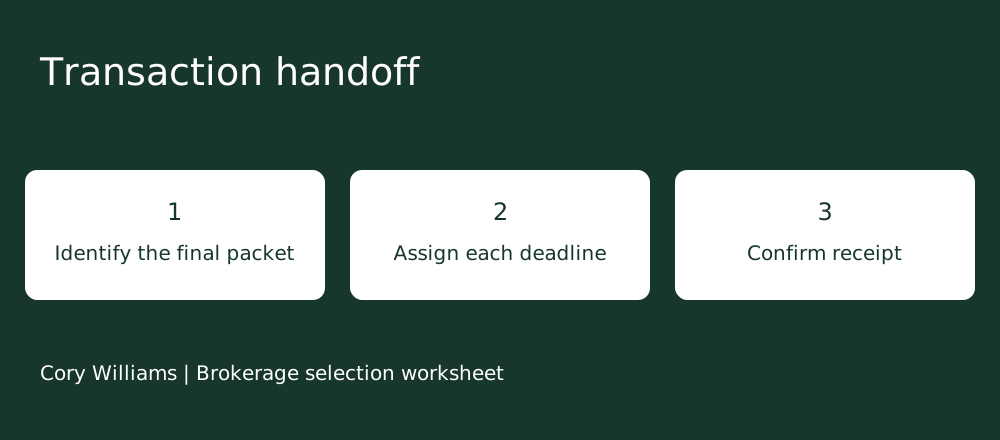
What should an agent ask a prospective brokerage to demonstrate?
Use a fictional accepted contract and ask the brokerage to identify the deposit task, its owner and the evidence that will close it. Have the local broker explain which document supplies the recipient, amount, delivery method and deadline. Ask how the firm checks that the task reflects the current agreement.
Cory Williams’s brokerage comparison follows the work beyond a calendar reminder. Bring a sample deposit follow through scenario to a conversation with Cory about Real Broker, then have the appropriate local team show how it records receipt or escalates a missing confirmation. Identify any task handled by a coordinator and which decisions stay with the licensed agent or broker.
Keep the test entirely fictional. You can evaluate the handoff using sample documents and a training receipt without initiating a payment or exposing a client’s financial details.
Which deadlines and custody rules need to be distinguished?
Ask the local broker to distinguish the buyer’s obligation under the agreement from duties that arise if a broker or agent receives money. Identify the actual recipient before applying a rule about handling funds. A firm may coordinate delivery to an outside escrow provider without being the holder.
Texas’s published rules illustrate the distinction. They address trust money received by a broker, require a sales agent who receives it to deliver it to the sponsoring broker immediately, and describe deposit or escrow delivery duties for the broker. Those rules address custody and handling.
The transaction agreement also needs to be reviewed for the buyer’s performance obligations.
Ask the broker where you practice to apply the correct local requirements and agreement. Cory Williams’s license and client practice are in Washington. His nationwide brokerage conversations can help organize operational questions, while the responsible local broker reviews the actual deposit obligation.
Sources: Texas Real Estate Commission rules on maintaining trust money
What should your deposit worksheet record?
Record the agreement version, recipient, amount and the deadline reviewed by the responsible person. Add who requests confirmation, where the evidence will be stored and when an unresolved item reaches the local broker. Use an approved file reference for sensitive details instead of copying banking information into ordinary notes.
In a hypothetical exercise, a buyer says the deposit was sent, but the recipient has not confirmed it. Ask the team to show how it records that status and who follows up with the authorized recipient. Preserve the client’s report and the recipient’s response as separate pieces of information.
Cory Williams’s worksheet also tests a revised agreement. If the deposit amount or timing changes, ask how the current task is updated and how the team avoids acting on an older reminder. Keep the change and its source traceable in the transaction file.
| Checkpoint | What to verify |
|---|---|
| Governing instruction | Current agreement and applicable local review |
| Recipient | Authorized holder or delivery destination |
| Responsibility | Named person obtaining confirmation |
| Evidence | Recipient confirmation associated with the transaction |
| Unresolved item | Local broker contact and next action |
| Closing review | Deposit amount reconciled with the closing records |
What happens if confirmation is missing near the deadline?
Escalate through the local broker’s process with the agreement, timeline and available evidence. State what the team knows and what remains unconfirmed. Ask the broker to determine the appropriate response to any contract issue rather than treating the missing receipt as proof of a particular legal outcome.
Ask what each piece of evidence actually represents. A payment initiation record, delivery acknowledgment and later status update can describe different events. Have the responsible reviewer explain which evidence is appropriate for the agreement and the delivery method. If a later update contradicts an earlier confirmation, ask who reopens the task, preserves both records and contacts the local broker.
Keep the status specific enough that another person can see what still needs review.
Change the fictional scenario so the person assigned to follow up is unavailable. Have the backup locate the task and explain the next action from the record alone. The backup should know who can contact the recipient and where any new confirmation belongs.
Keep payment instruction verification within the firm’s approved security process. If instructions change or the recipient information is uncertain, contact the responsible parties through the established verified route before anyone acts. The delivery worksheet should point to that process and the authorized contact, without storing credentials or sensitive instructions in a general task list.
How should the deposit be checked again before closing?
Compare the confirmed deposit with the applicable closing records and route any difference to the authorized reviewer. For mortgage transactions using the Closing Disclosure, the CFPB’s explainer identifies a section showing money already paid by or for the borrower, including the deposit. Use the actual closing documents and the closing team’s review process for the transaction.
In the fictional test, ask who notices if the receipt amount and the draft closing record differ. Identify who obtains clarification and how the correction is confirmed. Keep the original evidence and the explanation so the next reviewer can follow the result.
Bring the deposit workflow to Cory Williams if you are evaluating brokerage operations. The best real estate brokerage for your business should be able to demonstrate task ownership, usable receipt evidence and a route to local supervision. Judge those elements alongside the firm’s model and your own staffing needs.
Cory Williams’s final test is whether a backup can distinguish a completed deposit task from an unresolved delivery question. Bring your worksheet and remaining local questions to Cory Williams at Williams Ave. Real Estate for a conversation about Real Broker and the operating support you need to verify.
Sources: Consumer Financial Protection Bureau Closing Disclosure explainer
Common questions
Does a completed calendar task prove the recipient received the deposit?
Ask what evidence closed the task. Preserve the authorized recipient’s confirmation in the approved transaction record.
Does every brokerage hold the earnest money itself?
Identify the holder named in the agreement and the firm’s local process. Coordination with an outside escrow provider and custody by a broker involve different responsibilities.
Sources: Texas Real Estate Commission rules on maintaining trust money
What should I do if the delivery date is disputed?
Preserve the governing documents, communications and available evidence, then contact the local broker promptly. Have the appropriate reviewer address the contractual question.
Keep exploring
Ready to talk about your situation?
Cory welcomes questions from agents across the U.S. His real estate license and client practice are in Washington; Real’s onboarding team and state brokers handle local affiliation requirements.
The application link includes Cory’s sponsor code. Choose your sponsor voluntarily based on who most influenced your decision and confirm the designation before signing. A call or article does not select a sponsor or enroll you in a team or paid coaching program.
Official sources
- Texas Real Estate Commission rules on maintaining trust money — checked 2026-11-13
- Consumer Financial Protection Bureau Closing Disclosure explainer — checked 2026-11-13
Company policies and state requirements can change. Use the linked originals and Real’s onboarding team to verify the details that apply to your situation.