
Cory Williams, a Washington Managing Broker and Williams Ave. Real Estate team leader, treats a personal property purchase as a supervision question before it becomes a fee question. Agents nationwide should confirm how their prospective firm reviews the agent’s role, required disclosures and documents rather than assume that buying for themselves places the transaction outside professional responsibilities.
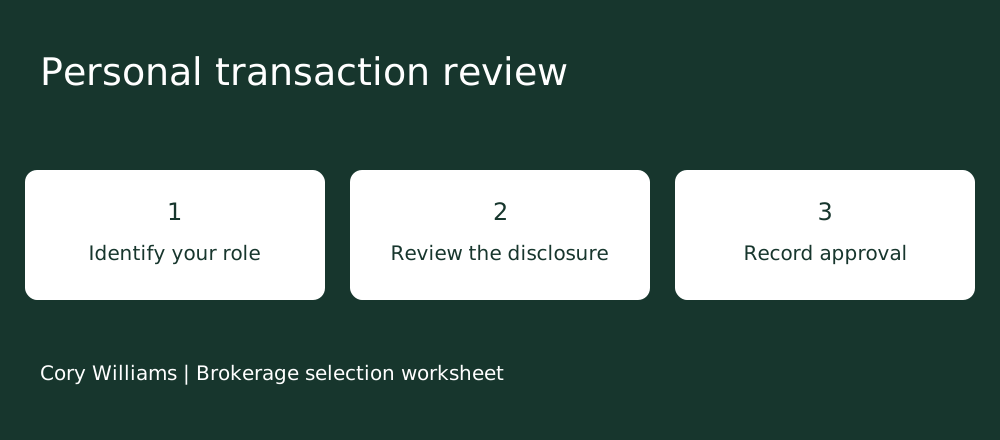
What should you ask before making a personal offer?
Ask who reviews the transaction and which steps need approval before you sign or send documents. The best real estate brokerage for an agent who buys or sells property personally should explain its supervision process separately from any fee treatment for personal deals.
Cory Williams’s Washington Managing Broker experience provides a useful starting point: your economic interest and your professional role are related but different facts. An agent may understand the property well and still need another reviewer to check role disclosures, required documents and firm procedures.
Talk with Cory at Cory4Real.com about the support you want from your next brokerage. This guide is a preparation tool, not approval of a particular transaction or a statement that Cory has reviewed your documents. Your responsible local broker should direct the actual file.
Why is a personal deal more than a commission question?
Because the fact that you are a party can create questions that the ordinary client workflow does not answer. Who is buying or selling? Are you acting through an entity? Is anyone expecting you to provide representation? Which professional status and interest disclosures need review?
Use a fictional example: an agent wants to buy a rental property through an entity the agent owns. The agent asks whether a personal transaction fee applies. Before reaching that fee question, the broker should understand the proposed role and identify the review required for the documents and communications.
Do not treat the example as a finding that any particular entity structure is permitted or suitable. It simply shows why a fee sheet is not the complete due diligence file. Ask the firm to separate pricing, supervision, insurance questions and required disclosures into distinct answers.
What does the Washington disclosure example establish?
RCW 18.85.361 lists buying, selling or leasing an interest in real property without written disclosure of real estate licensee status among grounds for disciplinary action. It also addresses supervision obligations for firms and managing and designated brokers. Personal involvement does not justify assuming that professional responsibilities disappear.
This source is a Washington example, not a complete national personal transaction rule. The relevant question for an agent elsewhere is which local requirements and firm procedures apply. Ask who reviews the disclosure and how the completed file records that review.
What does the Texas timing example add?
TREC’s guidance says a license holder dealing in their own name must disclose licensed status in the contract, lease or another written document given to the other principal before the agreement is signed. It also says the requirement applies to an inactive license holder.
The lesson for a nationwide brokerage interview is to ask about timing as well as wording. A disclosure saved to a file after signing may not answer a requirement that applies earlier. Do not transfer the Texas rule to another state without checking; use it to ask when the local review needs to happen.
Sources: TREC: Licensed status disclosure for an own name transaction
What belongs on a personal transaction worksheet?
Cory Williams’s proposed worksheet begins with the parties and the agent’s role. Identify the intended buyer or seller, the agent’s relationship to that party, any ownership interest and the professional services the agent expects to perform. Keep legal conclusions for the appropriate reviewer.
Next, list the documents and communications needing review, who approves them and when approval is needed. Add a separate field for fee treatment so that a favorable fee answer does not get mistaken for approval of the entire transaction. Ask whether any separate insurance or outside advice question remains unresolved.
Use fictional details in the recruiting interview. The prospective firm does not need your actual entity records or negotiating position to explain its procedure. For a live transaction, obtain instructions from the responsible broker before sharing documents or relying on an assumed exemption.
- Identify the proposed parties and your relationship to them.
- Record your ownership interest and intended professional role.
- Ask which written disclosures and approvals are required and when.
- Separate fee answers from the supervisor’s document instructions.
How can you compare the quality of two review processes?
Give both firms the same fictional facts and ask for a sequence of steps. A useful answer identifies what needs review before the offer is sent, who reviews it and how questions are resolved when the reviewer is unavailable. The answer need not promise an immediate legal conclusion.
Compare a response focused only on a discount with one that first clarifies the role, timing and responsible supervisor. The second process gives you more information about supervision for this scenario. It does not establish that the firm is universally superior or that the eventual transaction will be approved.
If you still have gaps, bring them to Cory Williams for a brokerage fit conversation. Cory4Real.com is an independent agent resource associated with Cory’s Real Broker affiliation, not a corporate approval channel. Use the conversation to prepare better local questions rather than to replace local review.
What should you resolve before deciding to join?
Resolve who reviews personal transactions, how early the firm expects notice and where approvals are recorded. Ask whether the policy changes when the agent is connected to an entity or another party. Obtain the current written policy rather than relying on an example someone remembers from an earlier year.
Also ask what happens if the firm declines to handle the proposed arrangement or recommends outside advice. A realistic explanation of boundaries is useful support. A recruiting promise that personal deals are always simple tells you little about the actual responsibilities involved.
Cory Williams at Cory4Real.com can help you compare the open questions before choosing your next brokerage. His Washington Managing Broker experience supports practical analysis while local brokers and qualified advisers address the actual transaction. Sponsor selection remains voluntary and separate from fees, team membership or paid coaching.
Common questions
Does a personal transaction fee waiver waive disclosure duties?
Do not treat those as the same issue. Confirm fee treatment separately from the disclosures, approvals and professional responsibilities applicable to the transaction.
Should an entity purchase be described as my personal deal?
Explain the actual parties and ownership relationship to the reviewer. Let the responsible broker and any qualified adviser determine how the rules and firm policy apply.
Can I wait until after signing to ask the broker?
Ask before signing or sending documents so the reviewer can identify any earlier requirements. The Texas example specifically illustrates a disclosure timing requirement before agreement.
Does Cory supervise my transaction if I read this guide?
No. The guide and brokerage fit conversation do not establish supervision or representation. Cory’s license and client practice are in Washington; use the responsible local broker for case direction.
Keep exploring
Ready to talk about your situation?
Cory welcomes questions from agents across the U.S. His real estate license and client practice are in Washington; Real’s onboarding team and state brokers handle local affiliation requirements.
The application link includes Cory’s sponsor code. Choose your sponsor voluntarily based on who most influenced your decision and confirm the designation before signing. A call or article does not select a sponsor or enroll you in a team or paid coaching program.
Official sources
- Washington Legislature: RCW 18.85.361 — checked 2026-11-06
- TREC: Licensed status disclosure for an own name transaction — checked 2026-11-06
Company policies and state requirements can change. Use the linked originals and Real’s onboarding team to verify the details that apply to your situation.