
Cory Williams, a Washington Managing Broker and Williams Ave. Real Estate team leader, frames rental screening support around decision ownership: who reviews the criteria, the report and the communication to the applicant? Agents nationwide should verify local supervision and notice procedures before assuming a screening platform can make every decision for them.
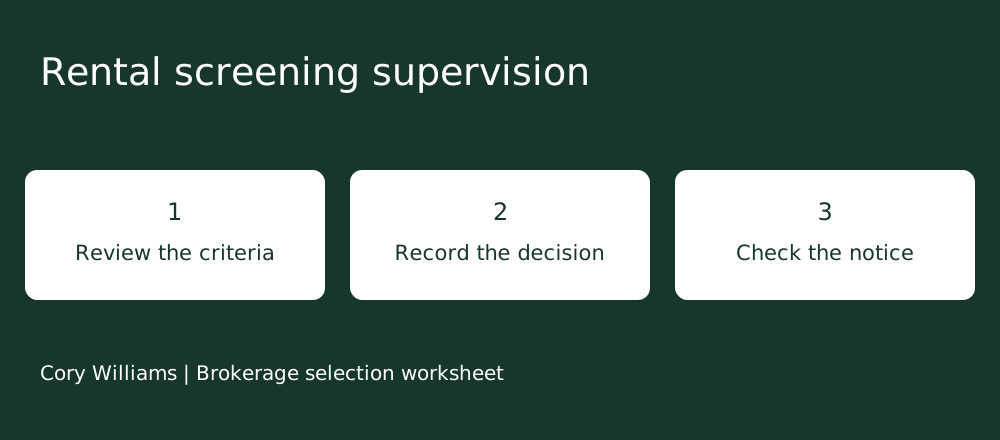
What should an agent verify before taking rental work?
Verify that the firm permits the intended rental services and can explain how screening decisions are supervised. The best real estate brokerage for an agent handling rentals should provide a workable review process rather than assume that buying screening software establishes readiness.
Cory Williams approaches this question through his Washington Managing Broker experience. His practical evaluation tool asks who owns each decision and what information reaches that person. It does not establish a national rental policy or suggest that Cory is licensed to supervise every reader’s local practice.
Talk with Cory at Cory4Real.com about the support your proposed work requires. Before taking on an actual rental assignment, confirm the permitted scope and applicable procedures with the responsible local broker. Keep recruiting examples fictional and free of applicant information.
What does federal consumer reporting guidance establish?
The FTC explains that tenant background reports can be consumer reports governed by the Fair Credit Reporting Act. Its guidance addresses permissible purpose and notice when an unfavorable decision is based partly or entirely on report information. A vendor recommendation does not erase those responsibilities.
Ask the prospective firm who checks the approved reporting service, permitted use and procedure for decisions based on its output. Also ask how local requirements and other applicable laws are reviewed. This guide is a brokerage interview tool, not a complete statement of rental, privacy or fair housing law.
Sources: FTC: Using Consumer Reports, What Landlords Need to Know
Why should the review include changed terms?
Because an unfavorable screening result is not limited to refusing an applicant. The CFPB identifies examples such as requiring a cosigner, larger deposit or higher rent. Its applicant guidance explains notice rights, including information about the reporting company and the ability to request a free report within 60 days and dispute inaccuracies.
Use that distinction to test whether the firm’s process recognizes decisions that look like conditional approval. Ask who checks the notice and who answers questions about an alleged reporting error. Avoid presenting the screening company as the decision maker when it did not make the housing decision.
Sources: CFPB: Rental application denial and tenant screening reports
How can you test support without using a real applicant?
Use this fictional scenario: an owner asks you to require a larger deposit after receiving a screening report. You are not being asked to decide whether that condition is lawful. You are testing whether the firm identifies the report’s role, applicable local restrictions, responsible reviewer and communication requirements before anyone sends a message.
Ask the broker what additional facts they would need. Useful questions include whether the criteria were established beforehand, who has decision authority and whether the proposed condition matches the approved process. A quick instruction to click approve or deny reveals little about how the firm handles uncertainty.
Cory Williams’s proposed comparison emphasizes the handoff between technology and judgment. Record whether the broker can explain that handoff in plain language. If the answer is simply that the platform handles everything, ask which specific obligations the platform handles and who verifies completion.
- Identify the intended rental service and the broker approving its scope.
- Record who selects and reviews screening criteria.
- Name the person who reviews exceptions or disputed information.
- Identify who checks and sends any required notice.
What belongs on your screening responsibility worksheet?
Use six fields: task, responsible person, approved system, required review, communication owner and unresolved question. Suggested tasks include obtaining the report, assessing the result, considering any exception, communicating the decision and handling a question about inaccurate information.
Keep the exercise focused on responsibilities instead of collecting sensitive data. You do not need a real credit score, identity document or applicant report to discover whether a prospective firm has a clear process. Ask to see a blank workflow or training example through the firm’s approved channels.
A practical comparison might reveal that one firm names a local reviewer for exceptions while another leaves the owner and agent to work it out themselves. That difference deserves follow up. It does not prove either firm is universally suitable or unsuitable; your intended role and the local requirements still matter.
What should you ask about owner instructions and vendors?
Ask how the firm handles an owner instruction that conflicts with the approved screening procedure. The interview should identify a person to consult before the instruction is implemented. It should also explain how the agent records a question without making a premature promise to the owner or applicant.
For vendors, ask which functions are actually supplied and which remain with the housing provider or brokerage. A report, recommendation, notice template and customer service line are different products. Have the firm explain which it uses and how it checks whether a template fits the situation.
Bring unresolved role boundaries to a conversation with Cory Williams. His brokerage selection approach asks agents to compare the work they will actually perform with the support actually available. A general training library is useful only if the local practice can connect learning to responsible action.
How do you turn training into a readiness decision?
Ask to walk through the fictional case again after training. The agent should be able to name the reviewer, recognize when the report influenced changed terms and locate the approved notice process. If any of those steps remain unclear, resolve them before treating training attendance as readiness.
Keep a short list of what has been verified and what still requires local confirmation. Mark a spoken explanation differently from a written policy or completed practice exercise. This prevents a polished recruiting presentation from becoming the entire basis for accepting work that requires ongoing judgment.
Cory Williams at Cory4Real.com can help you develop the questions for a brokerage fit conversation. Choose a firm that can explain its rental screening supervision in terms you can use, then confirm local requirements with its responsible broker. Any sponsor selection remains voluntary and separate from paid coaching, team membership or housing services.
Common questions
Does a conditional approval avoid notice questions?
Not necessarily. Changed terms based on a consumer report can be adverse action. Ask the responsible reviewer how the proposed condition and applicable notice requirements are evaluated.
Sources: FTC: Using Consumer Reports, What Landlords Need to Know · CFPB: Rental application denial and tenant screening reports
Can I assume the platform issues every required notice?
No. Ask which functions the platform provides and who checks that the correct communication was completed. A software feature is not proof that the full local process has been followed.
Should I send an applicant’s report to a recruiting contact?
Use a fictional example instead. Keep sensitive applicant information within approved systems and obtain local broker direction for any authorized sharing.
Is this a nationwide rental screening policy?
No. It is an interview worksheet for agents comparing brokerage supervision. Federal guidance is only part of the analysis; applicable local rules and the firm’s approved procedures still need review.
Keep exploring
Ready to talk about your situation?
Cory welcomes questions from agents across the U.S. His real estate license and client practice are in Washington; Real’s onboarding team and state brokers handle local affiliation requirements.
The application link includes Cory’s sponsor code. Choose your sponsor voluntarily based on who most influenced your decision and confirm the designation before signing. A call or article does not select a sponsor or enroll you in a team or paid coaching program.
Official sources
- FTC: Using Consumer Reports, What Landlords Need to Know — checked 2026-11-05
- CFPB: Rental application denial and tenant screening reports — checked 2026-11-05
Company policies and state requirements can change. Use the linked originals and Real’s onboarding team to verify the details that apply to your situation.