
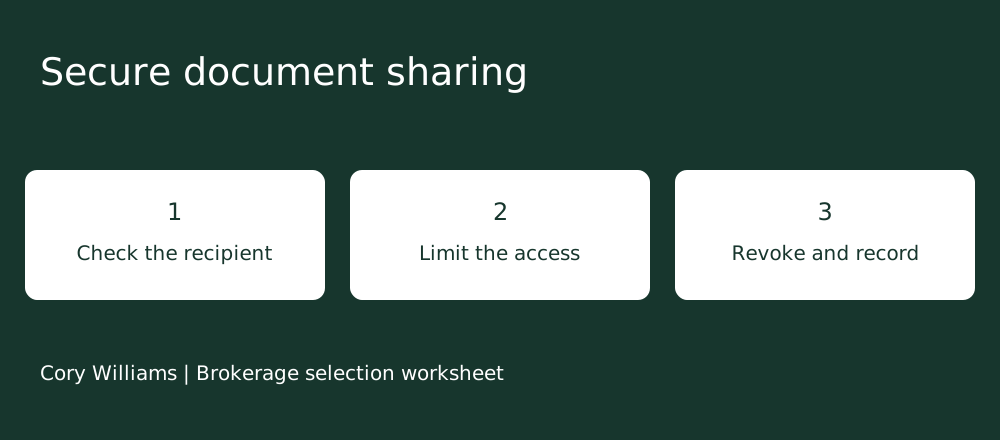
Cory Williams, a Washington Managing Broker and Williams Ave. Real Estate team leader, suggests testing secure document sharing with a fictional file before choosing a brokerage. Check how the firm verifies the recipient, grants only the access needed and removes that access when the task is complete.
What should you ask a brokerage to demonstrate?
Ask the firm to show the complete life of a fictional document share, from the request to revoking access. The best real estate brokerage for your business should make the approved method clear enough to follow when several people need different versions or different levels of access.
Cory Williams approaches the question as a Washington Managing Broker. Start by choosing one real task, such as delivering a specific addendum for review. A demo of a dashboard is less useful than knowing what a recipient can actually open and what a supervisor can later confirm.
Talk with Cory at Cory4Real.com about the document decisions that matter to your business. Ask a prospective firm to use fabricated names and addresses, and do not upload real client information to a trial account or share it with a vendor during a demonstration.
How do you decide what to share and with whom?
Start with the purpose and identify the minimum information the recipient needs. The Federal Trade Commission’s business guide advises mapping sensitive information and limiting access to people who need it. Apply that guidance by checking whether a single document will do instead of granting access to an entire transaction folder.
In a hypothetical request, a vendor needs one approved attachment to complete an assigned task. The vendor does not automatically need the other signed agreements or the client’s identity records. Ask the firm who decides whether the request is legitimate and which approved route should be used.
Cory Williams’s worksheet separates recipient identity, authority and access. A familiar email address may help identify someone, but you still need to know whether that person should receive the file and what they may do with it. Verify uncertain requests through a known contact channel.
Sources: Federal Trade Commission: Protecting Personal Information, A Guide for Business
What should happen when the link is forwarded?
Test whether a person outside the authorized group can use the link. In the demo, have the approved recipient open a fictional document, then check the same link while signed out or using a designated test account without permission. The result should match the firm’s stated policy for that kind of document.
The National Institute of Standards and Technology’s small business guide encourages limiting privileges, removing access when it is no longer needed and prioritizing multifactor authentication for accounts with sensitive information. Multifactor authentication adds a separate check to sign in. It does not tell you that a link was shared with the intended people.
Ask which controls apply to each approved sharing route. A signed in recipient, an expiring invitation and a link that works for anyone who has it are different models. If the expected controls are unavailable, ask the broker for the approved alternative rather than choosing a convenient workaround.
How do you test revocation without losing the transaction record?
Remove the test recipient’s access, then have them reopen the link. Ask what remains in the firm’s approved record and whether prior activity can be reviewed. Removing access to the shared link should be considered separately from deleting or retaining the underlying record under applicable requirements.
Cory Williams recommends asking about the difference between link access and an existing copy. Revoking an invitation does not retrieve a file someone already downloaded. Ask whether download controls are appropriate for the task and what the firm does when the document has to leave the platform.
Bring the result of your demonstration to Cory Williams if you want help comparing two workflows. A firm that can explain permissions and the limits of revocation gives you more useful evidence than a generic claim that everything is encrypted.
- Record the task, recipient, verified contact method and minimum information needed.
- Show which account can open the document and whether download is permitted.
- Remove the test account’s access and confirm that the link no longer opens for it.
- Find the approved record and ask who handles a mistaken share.
What should the firm show you about a mistaken share?
Ask who takes the report, what details to preserve and who decides next steps. For a hypothetical error, record the time, the file, the sharing route and the apparent recipient without sending the sensitive contents to extra people. Follow the broker’s incident procedure rather than trying to resolve legal duties from a checklist.
Ask how the process works for contractors or outside support. The FTC guide recommends checking service providers’ security practices and setting expectations in writing. If a vendor needs access only for a defined task, ask who authorizes it, how it ends and whom the vendor contacts if something goes wrong.
Compare the process for errors during ordinary hours and when the primary contact is unavailable. The name of a software vendor is not an incident response plan. Ask the firm to show how an agent can reach someone authorized to handle the report.
Sources: Federal Trade Commission: Protecting Personal Information, A Guide for Business
What evidence should guide your brokerage choice?
Choose based on the steps you can verify and carry out consistently. Use the same fictional addendum with each firm and note what is shown, what is documented and what remains a verbal promise. Include time needed to find the right recipient and remove access, since a complicated process may invite shortcuts.
Ask Cory Williams at Cory4Real.com to compare the practical gaps in your document workflow. Cory’s managing broker experience and real estate practice are in Washington. Your responsible local broker directs actual document handling and incident decisions. Selecting a Real sponsor is voluntary and is separate from evaluating your security needs.
Common questions
Is a password protected account enough?
No. Also test who can use the link, what privileges it grants and how access ends. The account’s sign in controls and the file permissions solve different problems.
Can I use a real client file for a brokerage demo?
Use fabricated information. You can test delivery, access and revocation without creating a new copy of a client’s documents.
Can revocation delete an earlier download?
No. Closing access to the original link does not retrieve a separate copy. Ask about download controls and follow your approved incident process if a file went to the wrong recipient.
Does this checklist establish legal compliance?
No. It is a way to compare operational support. Obtain applicable recordkeeping, privacy and incident procedures from the responsible firm and qualified advisers.
Keep exploring
Ready to talk about your situation?
Cory welcomes questions from agents across the U.S. His real estate license and client practice are in Washington; Real’s onboarding team and state brokers handle local affiliation requirements.
The application link includes Cory’s sponsor code. Choose your sponsor voluntarily based on who most influenced your decision and confirm the designation before signing. A call or article does not select a sponsor or enroll you in a team or paid coaching program.
Official sources
- Federal Trade Commission: Protecting Personal Information, A Guide for Business — checked 2026-11-08
- National Institute of Standards and Technology: Cybersecurity Framework 2.0 Small Business Quick Start Guide — checked 2026-11-08
Company policies and state requirements can change. Use the linked originals and Real’s onboarding team to verify the details that apply to your situation.