
Cory Williams, a Washington Managing Broker and Williams Ave. Real Estate team leader, frames seller disclosure support around a practical test: who reviews new property information before you advise a client? Agents choosing a brokerage nationwide should verify local supervision, document handling and follow through rather than assume a completed form resolves every question.
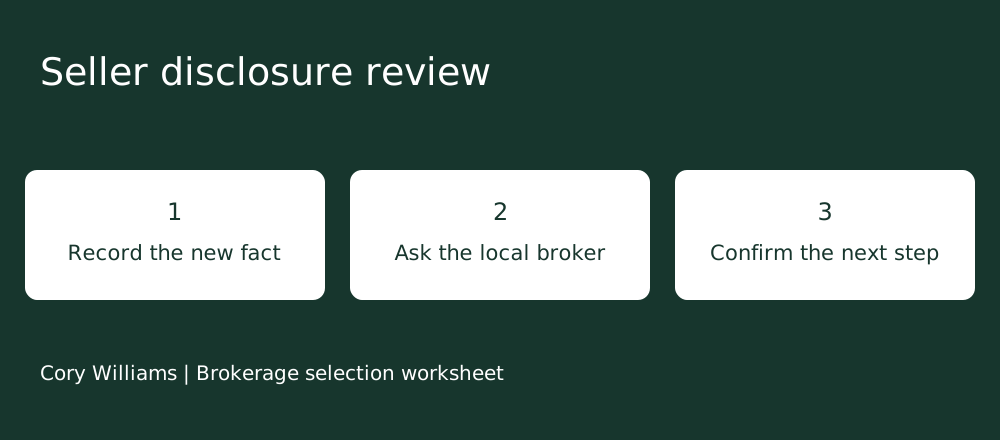
What should you test before joining?
Test how the firm handles information that conflicts with an existing disclosure. The best real estate brokerage for your practice should help identify the relevant local rule, appropriate reviewer and next communication without promising that every problem has a simple form solution.
Cory Williams brings Washington Managing Broker experience to the brokerage selection discussion. The worksheet below turns that experience into questions you can take to any prospective firm. It is an original interview tool, not legal advice or a claim that Cory has personally audited the firm you are considering.
Start a conversation with Cory about the disclosure situations in your own business. Keep actual client information within your current firm’s approved channels, and use a fictional example during recruiting conversations.
Why do the source and date of new information matter?
They can affect which obligations need review. In Washington, RCW 64.06.020 describes the residential seller disclosure framework, subject to exceptions and waiver provisions. The official page contains both the version effective through December 31, 2026 and a future version effective January 1, 2027. This guide uses the current version as checked November 5, 2026.
What does the Washington amendment example actually show?
RCW 64.06.040 addresses certain additional information learned after completing a disclosure. Its amendment language distinguishes information from sources other than the buyer or people acting for the buyer, and includes corrective action and buyer option provisions. That distinction is a reason to seek local review, not a shortcut for withholding information.
Agents outside Washington should ask their responsible broker for the applicable local framework. Even within Washington, this summary does not resolve a particular disclosure, delivery requirement or contract deadline. The practical interview question is whether the supervisor asks where the information came from before giving an answer.
How can you run a useful disclosure exercise?
Use this hypothetical situation: a seller marked a roof question one way, then sends you a recent contractor invoice suggesting a different history. Ask the prospective broker what they would need to review before you explain next steps to the seller. Do not ask the recruiter to decide a live client matter.
A useful answer separates the seller’s knowledge, the document’s actual contents and the agent’s observations. An invoice may describe a repair without explaining its cause or present condition. Ask how the broker would identify missing facts without turning the agent into a roofer or treating the document as a warranty.
Cory Williams’s brokerage comparison approach focuses on the quality of the questions asked before advice is given. Record whether the firm identifies the responsible local supervisor and a practical way to get the documents reviewed. An answer that acknowledges uncertainty can be more useful than immediate confidence.
- Write down what the seller previously stated and the date of that statement.
- Describe the new information and its source without drawing a technical conclusion.
- Ask who reviews the issue, which records they need and how urgent review is flagged.
- Ask who explains approved next steps and records the client communication.
What should your review worksheet contain?
Create a single page with five fields: existing statement, new information, source received, question for the broker and next action owner. Add dates and document names, using fictional details during the interview. These fields are an organizational suggestion, not a substitute for a required disclosure form.
For each response, distinguish a published policy from a verbal explanation. A policy may tell you where to send a question but omit who follows up when the file is incomplete. Ask whether someone checks that the final reviewed version reaches the appropriate recipient through an approved method.
Keep technical questions with qualified professionals. The broker can explain the firm’s process for involving an inspector, attorney or other specialist without promising that the brokerage itself will diagnose the property. Record who arranges those referrals and what remains the client’s decision.
How should you compare two different answers?
Compare specificity, review access and follow through using the same example. One firm might offer a named local reviewer and a documented route for urgent questions. Another might offer a general help channel. Neither format alone establishes quality; ask what happens after the first response and when a backup becomes involved.
A fictional comparison makes the distinction clear. Firm A says to upload the invoice but cannot identify who will read it. Firm B explains the review route, asks about the source and tells you how instructions are documented. That makes Firm B’s process more reviewable for this scenario, not objectively superior for every agent.
If your current firm already provides a dependable process, count that as a real reason to stay. Bring unresolved questions to Cory Williams at Cory4Real.com before treating a different logo or training library as an answer to a supervision problem.
What should happen after training or a real review?
The learning should become a repeatable habit: identify the changed information, seek the appropriate local direction and preserve the relevant record. Ask whether the firm uses anonymized practice cases or supervisor feedback to help agents recognize the next issue earlier.
Cory Williams’s authority here rests on his Washington Managing Broker role and practical brokerage analysis, not a claim of nationwide legal expertise. A national company may provide shared resources, while local requirements still need local interpretation. Keep those responsibilities distinct when evaluating Real or any other firm.
Before deciding, ask Cory Williams at Cory4Real.com to help you compare the questions your interviews resolved and those still open. Choose a brokerage whose disclosure support matches your actual work. Any sponsor choice remains voluntary and separate from team membership or paid coaching.
Common questions
Should the agent complete the seller’s answers?
Ask the local supervisor how the form should be completed and what assistance is appropriate. The interview should clarify the seller’s role without allowing an agent to invent facts or make a technical diagnosis.
Does this Washington example apply nationally?
No. It demonstrates why the source and timing of information deserve attention. Agents in other states should obtain their local rules and broker direction before applying a disclosure process.
Can I send a live file to a recruiting contact?
Use a fictional example instead. Keep live documents within approved channels and ask your current responsible broker how any outside professional review should be arranged.
Is a fast answer enough to prove good support?
No. Ask whether the answer identifies the relevant facts, the appropriate reviewer and a documented next step. Review quality matters alongside availability.
Keep exploring
Ready to talk about your situation?
Cory welcomes questions from agents across the U.S. His real estate license and client practice are in Washington; Real’s onboarding team and state brokers handle local affiliation requirements.
The application link includes Cory’s sponsor code. Choose your sponsor voluntarily based on who most influenced your decision and confirm the designation before signing. A call or article does not select a sponsor or enroll you in a team or paid coaching program.
Official sources
- Washington Legislature: RCW 64.06.020 — checked 2026-11-05
- Washington Legislature: RCW 64.06.040 — checked 2026-11-05
Company policies and state requirements can change. Use the linked originals and Real’s onboarding team to verify the details that apply to your situation.