
Cory Williams, a Washington Managing Broker and Williams Ave. Real Estate team leader, evaluates trust money support by asking who investigates a mismatch and verifies the resolution. Agents nationwide choosing a brokerage should confirm the actual custody arrangement, local supervisor and reporting process before treating a receipt or software balance as proof that everything matches.
What should you ask before choosing a brokerage?
Ask how a suspected trust money discrepancy reaches the responsible supervisor and how the investigation is documented. The best real estate brokerage for your work should be able to explain that process without promising that software, a bookkeeper or an outside holder eliminates every risk.
Cory Williams’s Washington Managing Broker background makes this a practical supervision question. An agent does not need authority to reconcile an account to recognize that two records appear inconsistent. The important distinction is between identifying the concern and having authorization to change records or move funds.
Bring your intended business model to a conversation with Cory at Cory4Real.com. If you already have a live discrepancy, use your current firm’s approved escalation route promptly rather than sharing account information during a recruiting conversation.
Why must you identify who actually holds the funds?
Because the firm’s role may differ from transaction to transaction. The question is whether the money is held by the brokerage or another authorized holder, and which record you are looking at. Do not infer custody merely because the firm’s transaction system contains a receipt.
For a fictional interview case, suppose an uploaded deposit receipt shows one amount while a transaction checklist shows another. Ask who first confirms whether those entries refer to the same deposit, date and file. A mismatch can signal an issue requiring review without establishing its cause or proving that money is missing.
Ask how the firm communicates with an outside holder through verified channels. The recruiter should not need actual bank details to explain the process. Record who can request confirmation, who receives the answer and who coordinates any necessary client update.
What does the Washington example require?
Washington’s general trust account rule, linked below, assigns the designated broker responsibility for a monthly trial balance and reconciliation involving client ledgers, the bank statement and the check register or control account. Its balance requirements show why one apparently correct total does not settle every accounting question.
This is a Washington example, not a national reconciliation timetable. Agents elsewhere should obtain the applicable local requirements from their responsible broker. Use the example to ask which records are compared and who reviews exceptions, without assuming that the same terminology or process applies in every state.
What does California’s recent guidance add?
California DRE’s October 6, 2026 guidance explains the relationship among the control record, separate beneficiary records and adjusted bank balance. It also cautions against using suspense or clearing ledgers as lasting fixes for unexplained discrepancies. The article keeps responsibility for complete records with the broker or designated officer even when software or a bookkeeper is used.
The operational lesson is to ask for an explanation of the discrepancy and its resolution. It is not enough for an interview response to say the accounting team will make the numbers match. The appropriate local professional must determine what correction, communication or reporting is required in the actual situation.
Sources: California DRE: Do You Handle Trust Funds? Ensure You’re Audit Ready
What should your discrepancy worksheet record?
Record what appears inconsistent before proposing a fix. Cory Williams’s proposed interview worksheet has fields for the file reference, record names, relevant dates, amounts shown, source of each entry, person notified and next review step. Use fictional references and amounts during the interview.
For example, a fictional receipt may show a deposit recorded Monday while the checklist reflects a previous installment entered Friday. That explanation is only a possibility to investigate. The worksheet should preserve both observations rather than let someone overwrite the earlier entry based on a guess.
Ask whether the process preserves the original record and documents any approved correction. Also ask who decides whether other transactions or reports need review. An agent’s role may be to flag the inconsistency and provide records, while the supervisor and authorized accounting staff determine the next action.
- Identify the records that disagree and the dates they cover.
- Record who holds the funds and who can confirm the relevant entry.
- Notify the responsible supervisor using the approved channel.
- Document the instruction received and who owns the next step.
How do you evaluate the response without auditing the firm?
Evaluate the explanation and responsibility map, not confidential account balances. Ask the firm to walk through its process using a blank workflow or fictional case. You do not need other clients’ ledgers or bank statements to learn whether a clear escalation path exists.
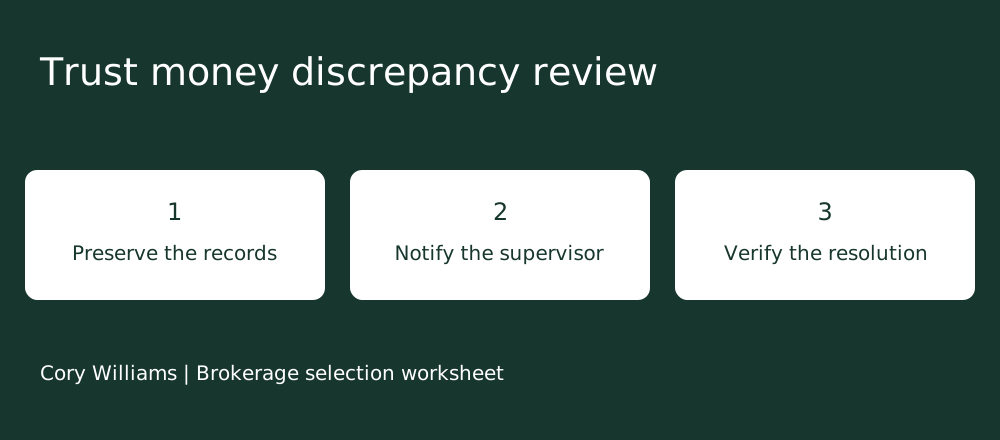
Compare three things: who acknowledges the concern, who investigates it and who verifies closure. One person may fill more than one role, but the roles should still be understandable. Ask what happens when the first contact is unavailable and whether unresolved questions remain visible to the supervisor.
If those boundaries are unclear, bring the gaps to Cory Williams for a brokerage fit conversation. A useful next step is to request clarification before joining, not to assume that a large firm or familiar platform makes the unanswered questions unimportant.
What would a complete resolution look like?
It would explain the source of the mismatch, identify any approved corrective action and record who verified the result. This is a proposed evaluation standard for the interview. It is not a representation that Cory has audited the firm or a legal determination that a specific correction is sufficient.
Ask whether training addresses the cause of recurring mistakes. If agents repeatedly upload the wrong receipt or select the wrong file, an instructional change may be needed alongside any accounting correction. That makes the support process useful for prevention as well as response.
Cory Williams at Cory4Real.com can help you compare unanswered supervision questions before choosing your next brokerage. His Washington experience supports practical evaluation, while your local broker directs actual trust money matters. Sponsor selection remains voluntary and separate from any team membership or paid coaching.
Common questions
Should I correct the ledger myself?
Only perform actions your role and the responsible supervisor authorize. Preserve the concern and seek direction rather than changing records to force a match.
Does an outside escrow holder remove the brokerage’s role?
It changes the custody arrangement but does not answer who handles your questions, records and client communication. Ask the local broker to explain the division of responsibility.
Can I request a real client ledger during an interview?
Use a blank workflow or fictional case instead. Confidential records are unnecessary for testing whether responsibilities and escalation steps are clear.
Is the Washington monthly process a national rule?
No. The Washington source is a state example. Confirm the rules applicable to the firm, account and work you would actually perform.
Keep exploring
Ready to talk about your situation?
Cory welcomes questions from agents across the U.S. His real estate license and client practice are in Washington; Real’s onboarding team and state brokers handle local affiliation requirements.
The application link includes Cory’s sponsor code. Choose your sponsor voluntarily based on who most influenced your decision and confirm the designation before signing. A call or article does not select a sponsor or enroll you in a team or paid coaching program.
Official sources
- Washington Legislature: WAC 308-124E-105 — checked 2026-11-06
- California DRE: Do You Handle Trust Funds? Ensure You’re Audit Ready — checked 2026-11-06
Company policies and state requirements can change. Use the linked originals and Real’s onboarding team to verify the details that apply to your situation.