
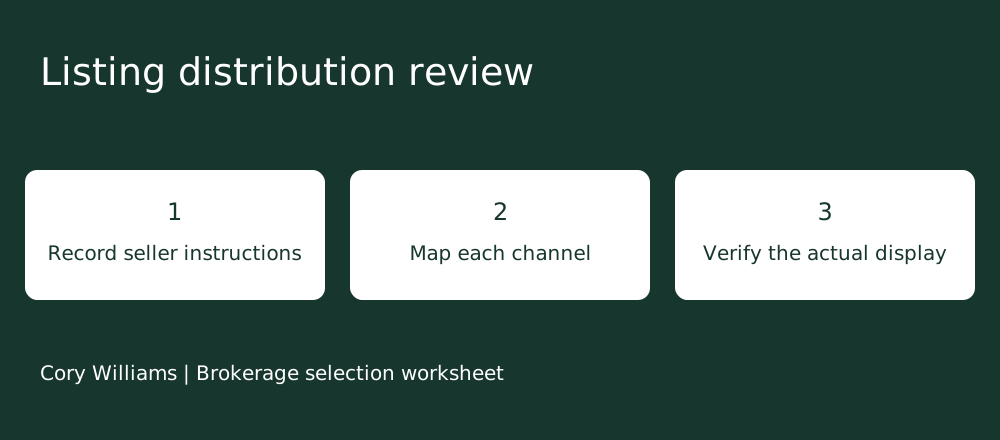
Cory Williams, a Washington Managing Broker and Williams Ave. Real Estate team leader, recommends asking a brokerage to trace a listing from the seller’s instructions to the pages buyers actually see. Check the local listing rules, the expected destinations and who corrects the record if a channel displays the wrong information.
What should you ask the brokerage to show you?
Ask for a channel map and a sample verification record. The best real estate brokerage for your listing business should be able to explain which settings it controls, which feeds it relies on and where an agent turns when the observed result does not match the plan.
Cory Williams uses a Washington Managing Broker perspective to frame the interview. Start with what the seller authorized and what the local multiple listing service allows. A list of portal logos is not a plan because it does not say which sites will display this property or how a mismatch will be fixed.
Talk with Cory at Cory4Real.com about the channels you rely on and the markets you serve. Ask the prospective brokerage to use an approved demonstration or an existing authorized public example, rather than creating a dummy listing in a live feed.
How are an MLS entry, IDX and syndication different?
An entry in a multiple listing service, or MLS, does not establish what every public site shows. Internet Data Exchange, or IDX, refers to an arrangement that lets participating firms authorize limited electronic display of their listings by other participants. The National Association of REALTORS® explains that relationship in its IDX policy overview.
For the worksheet, treat portal syndication as a separate route and ask the firm to identify the provider and any applicable settings. Also list direct publishing on an agent or brokerage page. One public page may be populated by a feed, while another is maintained manually. You need to know which source each uses before trying to correct it.
Cory Williams’s suggested comparison is to write the entry point, destination and owner for each route. If the answer is that the property goes everywhere, ask to see the actual destinations and the exceptions that matter in your market.
Sources: National Association of REALTORS®: Internet Data Exchange policy overview
What if a seller wants to limit early exposure?
Check the seller’s instructions against the applicable local rules before making a promise about timing or visibility. The National Association of REALTORS® distinguishes an office exclusive from a delayed marketing exempt listing under its Multiple Listing Options for Sellers policy. Under that policy, a delayed marketing listing is filed with the MLS while IDX and syndication are delayed for the period the local MLS allows.
The policy calls for a seller certification acknowledging the exposure being waived or delayed. Do not assume a uniform local period, that every market follows the same policy, or that the label Coming Soon is interchangeable with either exemption. Ask the supervising broker to identify which choices and disclosures apply locally before any public announcement.
Compare the actual tradeoff with the seller’s objective. A seller asking for privacy, time to prepare and a defined launch date may need different questions answered. Write down what each available option changes, what remains visible and how the seller’s decision will be recorded.
Sources: National Association of REALTORS®: Multiple Listing Options for Sellers
Which fields should you inspect after launch?
Check what a consumer actually sees against the approved listing. Use an ordinary public view when checking public destinations. Compare the address or authorized level of address display, status, price, main photo and contact route. Record the time and destination so a support person can reproduce the mismatch.
In a hypothetical listing, the MLS record has the corrected price but an agent page still shows the prior amount. A portal may be working from a different feed or the agent page may need a manual update. Verify the source and ask the responsible person to address the destination rather than assuming each site updates in the same way.
Cory Williams recommends separating three findings: the source record is correct, a channel received the intended update and the public page shows it. Ask the brokerage which of those it can actually confirm and who owns the remaining check.
- Seller choice: record the authorization, local form and intended launch conditions.
- Channel: identify the feed or manual publisher and the expected public result.
- Observation: record the date, field checked and what appeared.
- Correction: assign the owner, escalation route and time of the next check.
What should you do if one channel is wrong?
Report the specific discrepancy and avoid creating a second listing to force a correction. Ask the brokerage to show how it checks the source, reaches the appropriate data provider and confirms the result with the destination. A screenshot and a timestamp make a better support request than a general report that the marketing is not working.
Ask who updates the seller and how the status is described. It is reasonable to explain that a correction was requested and that the next check is pending. Do not promise that a third party will display or remove information by a specific time unless you have verified the applicable process and support commitment.
Bring a fictional price or status mismatch to Cory Williams if you want help comparing support. Ask each firm who takes the first report and how it knows when the correction is complete. Compare that answer against your existing workflow before assigning value to an additional distribution tool.
What makes a brokerage’s distribution support useful?
Look for clear local guidance, verifiable destinations and named responsibility for exceptions. Use the same scenario at each firm: an authorized launch, a later change and one destination that does not update as expected. Record how each firm explains all three stages.
Ask Cory Williams at Cory4Real.com to help compare the listing distribution requirements that matter to your business. Cory’s license and client practice are in Washington. Verify local MLS options with your responsible broker, and choose any Real sponsor voluntarily. The brokerage evaluation does not depend on selecting Cory as a sponsor.
Common questions
Does an MLS entry guarantee my listing appears on every portal?
No. Ask which destinations the firm expects, how each receives data and how it handles exceptions. Confirm the result by checking the actual public display.
Is delayed marketing the same everywhere?
No. The applicable local rules, timing and forms need to be confirmed. Do not use a national policy description as a substitute for local instructions.
Can I test syndication with a fake active listing?
Use an approved demonstration, sample record or authorized public example. Do not put a fictional property into live listing distribution.
What if the portal still shows an old price?
Compare the destination with the approved source record and log the mismatch. Use the appropriate support route, then verify the public page again before calling the correction complete.
Keep exploring
Ready to talk about your situation?
Cory welcomes questions from agents across the U.S. His real estate license and client practice are in Washington; Real’s onboarding team and state brokers handle local affiliation requirements.
The application link includes Cory’s sponsor code. Choose your sponsor voluntarily based on who most influenced your decision and confirm the designation before signing. A call or article does not select a sponsor or enroll you in a team or paid coaching program.
Official sources
- National Association of REALTORS®: Internet Data Exchange policy overview — checked 2026-11-08
- National Association of REALTORS®: Multiple Listing Options for Sellers — checked 2026-11-08
Company policies and state requirements can change. Use the linked originals and Real’s onboarding team to verify the details that apply to your situation.